Software Development Life Cycle (SDLC) Models
Explore the foundational frameworks used to manage the software development process, ensuring quality, efficiency, and project success.
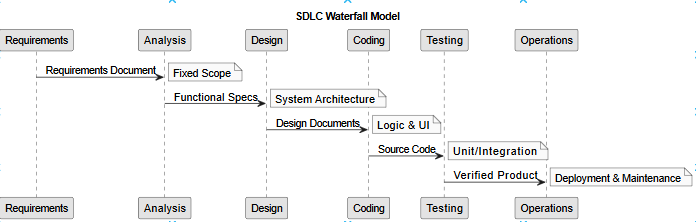
🌊 Waterfall Model
The Waterfall Model is a linear and sequential approach to software development. Each phase—Requirements, Analysis, Design, Coding, Testing, and Operations—must be completed in order. This model is most effective when requirements are stable and well-understood from the start.
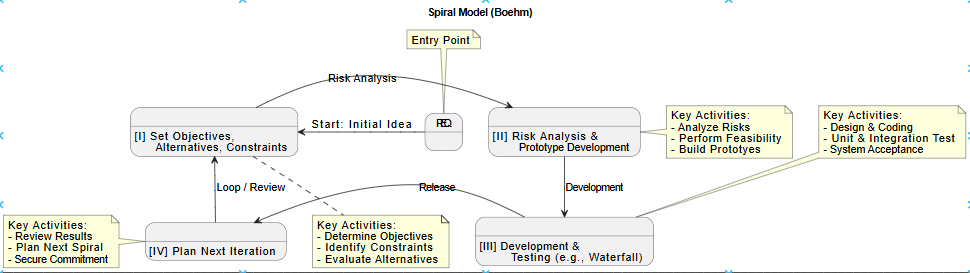
🌀 Spiral Model (Boehm)
The Spiral Model focuses on risk assessment and iterative development. It brings together the structured nature of the waterfall model with the flexibility of prototyping. By moving through repeated cycles of planning, risk analysis, and evaluation, it allows teams to manage complex projects with high uncertainty.
🔄 Evolutionary Development Model
The Evolutionary Model is based on the idea of developing an initial implementation, receiving user feedback, and evolving the software through multiple versions. This iterative process is ideal for systems where the full scope of requirements is likely to shift over time.

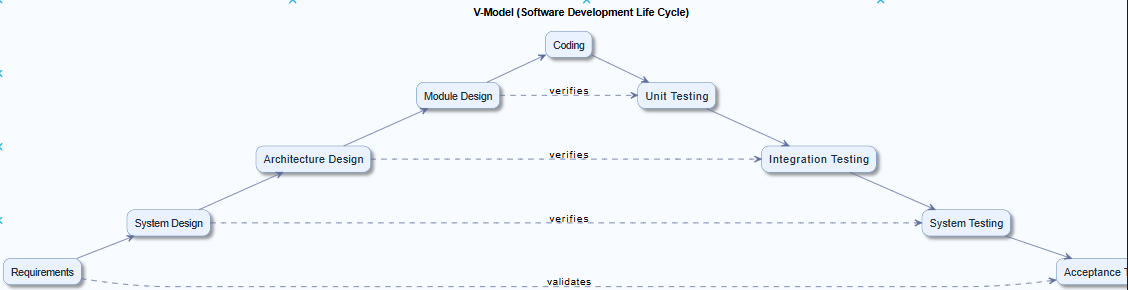
✅ V-Model (Validation & Verification)
The V-Model emphasizes the relationship between each stage of development and its corresponding stage of testing. Every development activity has a matching verification/validation step, ensuring that defects are caught early and the system meets all specified requirements.